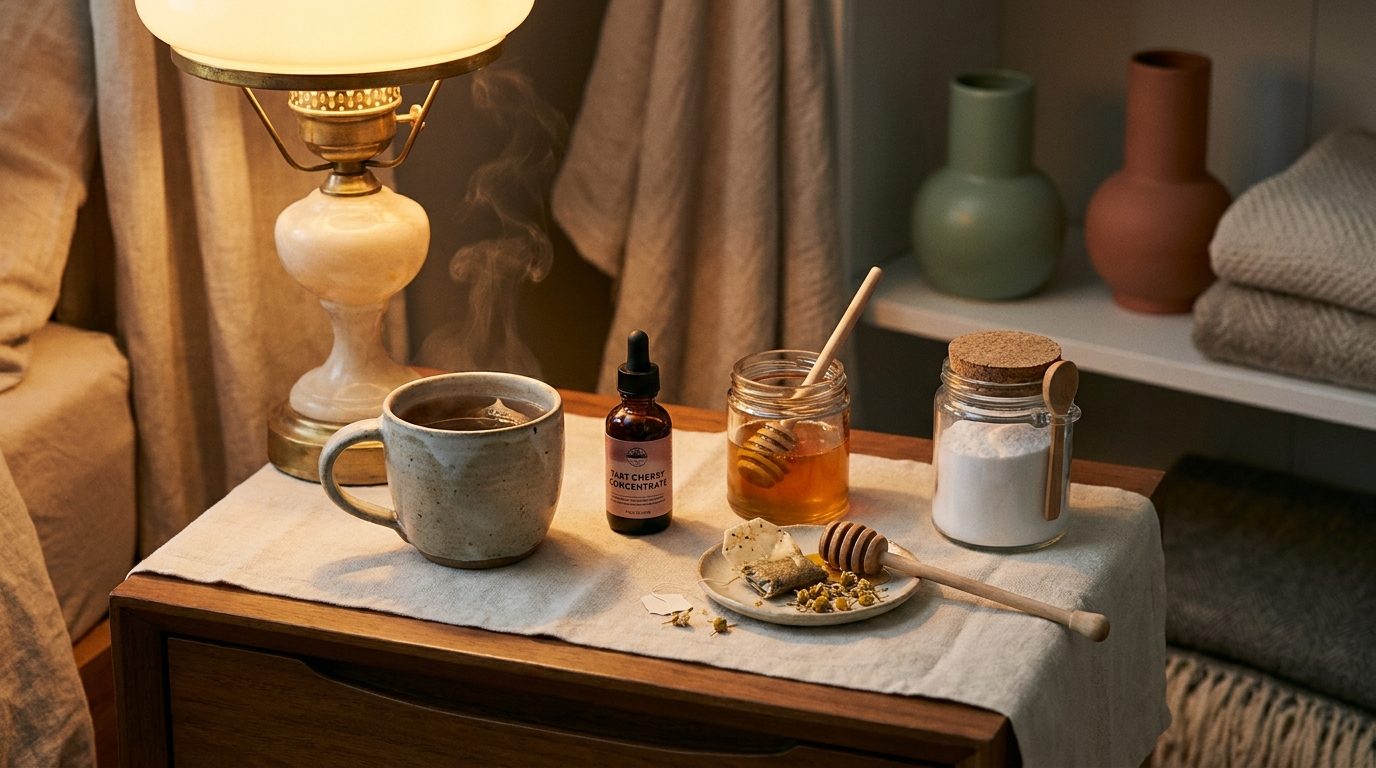
For about three years I tried every sleep gummy on the shelf. Some helped a little. Most felt like expensive candy. None of them stayed in my routine. The thing that finally did is a four-ingredient warm drink I make every night before bed. It costs about twenty dollars a month, the most expensive bottle in it lasts three months, and it does more for my fall-asleep time than any single supplement I've ever bought.
I want to give you the actual recipe, the order it goes together in, the math on why it lands under twenty dollars, and the honest reason the ritual matters as much as the ingredients.
The recipe
Four ingredients. About five minutes from kettle to mug. I make it around 9pm — about forty-five minutes before I want to be asleep.
- Eight ounces of hot chamomile tea. One bag, steeped six to seven minutes. Longer than the box says — the apigenin in chamomile binds to the same calming receptors as some prescription anti-anxiety medications, just at a much milder dose, and you want the longer steep to actually pull it out of the bag.
- One teaspoon of tart cherry juice concentrate. Tart cherries are one of the few natural sources of meaningful melatonin. A teaspoon of concentrate gives you maybe 0.1 milligrams of natural melatonin — close to what your body produces on its own at bedtime — without the tolerance issues of melatonin supplements. The concentrate is shelf-stable and a small bottle lasts months.
- One teaspoon of magnesium glycinate powder (about 300mg). The form matters enormously here. Oxide does nothing. Citrate hits your stomach harder than you want at bedtime. Glycinate is the form that crosses into the bloodstream and supports the GABA receptors involved in winding down. I buy the unflavored powder so it dissolves into the tea cleanly. If powder is hard to find, you can open a glycinate capsule instead. More on which magnesium form matters here.
- One teaspoon of raw honey. Two reasons. First, it tastes good — non-negotiable if you're going to drink something every night for the rest of your life. Second, a small amount of slow sugar at bedtime helps stabilize overnight blood glucose, which seems to reduce the 3am wake-up some people get when their blood sugar drops in the middle of the night.
Stir until the magnesium dissolves, take it back to the bedroom, sip it slowly while you wind down. The whole thing takes about ten minutes to drink, which is roughly the amount of time you want between "actively decompressing" and "trying to fall asleep."
The drink isn't a sleep aid. It's a sleep ritual that happens to contain things that support sleep. The ritual matters as much as the ingredients.
The math: how this lands under twenty dollars a month
This is the question I would have wanted answered before starting. Here are the actual costs.
- Chamomile tea, 50 bags for about $5. One bag per night = 10 cents a night, or about $3 a month.
- Tart cherry juice concentrate, 16oz bottle for about $15. A teaspoon a night means a bottle lasts about three months. That's $5 a month.
- Magnesium glycinate powder, 60 servings for about $25. One serving a night = $12.50 a month.
- Raw honey, 12oz jar for about $8. A teaspoon a night means the jar lasts four to six months. Call it $1.50 a month.
Total: about $22 a month at retail. If you buy the magnesium powder in a larger size or wait for a sale, it drops under $20 easily. Compared to a typical sleep gummy bottle that runs $25-$35 for a one-month supply, this is roughly the same money for actual measured doses of things that have research behind them.
Why this works better than sleep gummies
Three structural reasons.
The magnesium dose is real. The magnesium in most sleep gummies is between 50 and 100 milligrams of a glycinate-citrate blend. The research on magnesium for sleep generally uses doses around 300mg, which is what a teaspoon of pure powder delivers. Gummies have to balance taste with dose; powder doesn't.
The melatonin source is natural and small. Most sleep gummies contain 3 to 10 milligrams of synthetic melatonin — ten to a hundred times the dose your body would ever produce on its own. The tart cherry concentrate in this drink gives you something closer to a tenth of a milligram, which is what the research actually supports for sleep onset. Your receptors don't downregulate, you don't build tolerance, and you don't wake up groggy. (Longer take on the melatonin dosing problem here.)
The ritual is the actual mechanism. Drinking something warm and slightly sweet, in a low-light room, away from screens, for ten minutes — that is a strong behavioral signal to your nervous system that the day is over. The ingredients support sleep. The ritual is what actually shifts you out of the day. Gummies don't have a ritual. You chew them in 15 seconds and go right back to your phone.
What I'd tell someone starting this
A few honest notes from doing this every night for a year.
The first three nights will not feel different. The cumulative effect of magnesium takes about two weeks to fully show up. Tart cherry juice has been studied in the 7-to-10 day range. If you're going to try this, commit to two weeks before you decide whether it works.
The taste takes a couple of days to grow on you. Chamomile and tart cherry both have a slight bitter undertone the honey doesn't fully cover at first. After about a week your palate adjusts and the drink starts to taste like the warm-and-grounded thing you actually look forward to at bedtime.
The powder vs. capsule choice on magnesium is real. Powder dissolves cleanly into hot water and you get a more consistent dose. Capsules work — open the capsule, dump it in, stir — but the texture is grittier and there's a little powdery sediment at the bottom of the mug. If you can find pure glycinate powder, go that way.
Skip it on antibiotics. Magnesium binds to certain antibiotics in the gut and reduces their absorption. If you're on a course of antibiotics, pause the magnesium until two hours after your last dose of the day, or skip the drink entirely until the course is over.
The honest framing
This drink is not going to fix anyone's serious sleep problem on its own. If you have actual chronic insomnia, talk to a doctor. If you have sleep apnea, this isn't the intervention. But if you're someone with a normal life and a normal nervous system who can't seem to wind down at 10pm and ends up scrolling until midnight — this drink, made consistently for two weeks, will probably move your fall-asleep time by twenty to thirty minutes. It did mine.
It will also save you money. A monthly box of sleep gummies, a melatonin spray, a "sleep stack" subscription from any of the wellness brands currently advertising on Instagram — those all add up to forty or fifty dollars a month. This is one bag of chamomile, one bottle of concentrate, one bag of powder, one jar of honey. About twenty dollars. The cheaper option is also the one with better evidence behind it. That's usually how it works.

Heather Robles
Mom of four, teacher, and the founder of Wellness by Heather. I write honest, research-backed notes on the wellness products that actually earn a spot in my routine — and the ones that don't.