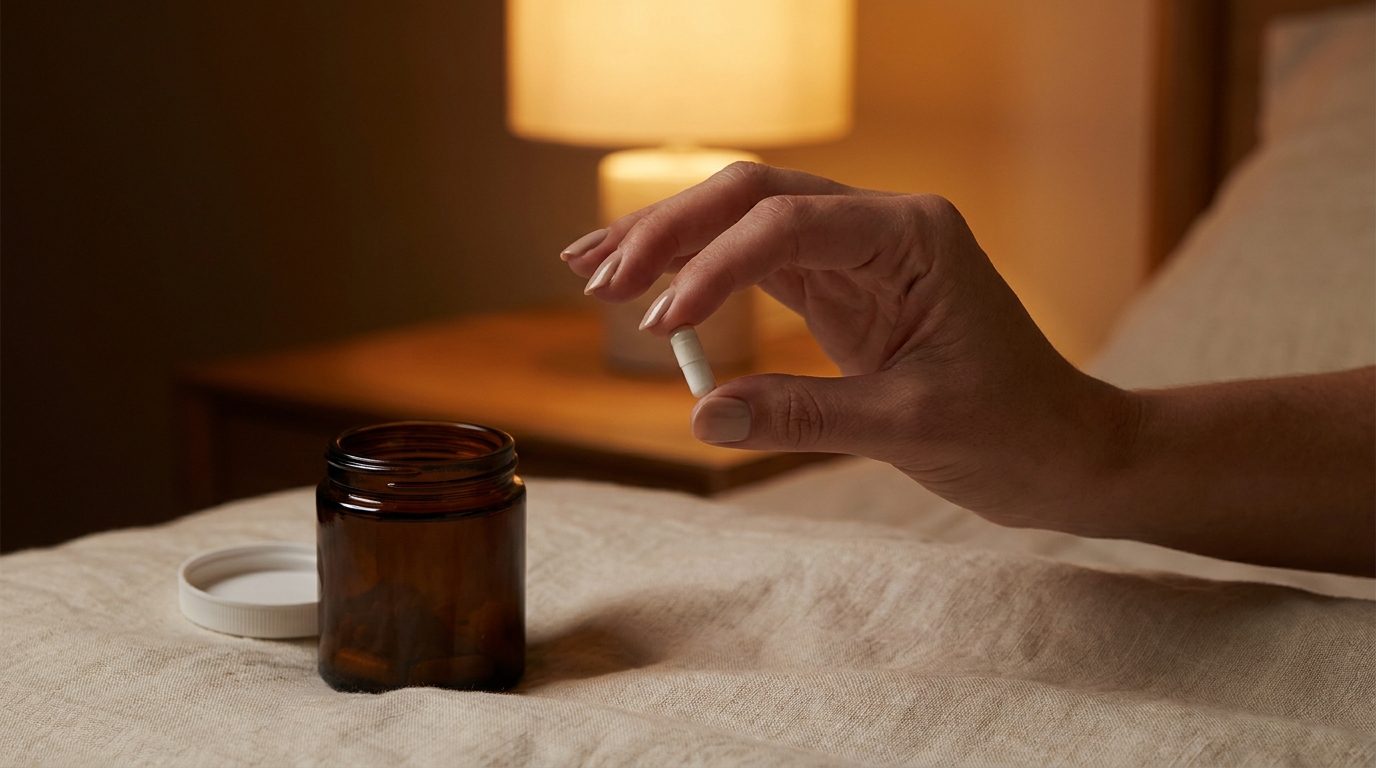
Melatonin worked beautifully for me for about two weeks. Then it stopped. I doubled the dose. It worked for another week. I doubled it again. Eventually I was taking 10 milligrams a night and lying awake at midnight wondering what was wrong with me. The answer turned out to be the supplement, not me.
The tolerance problem
Melatonin is a hormone your body already makes — your pineal gland releases small amounts in the evening as light fades. The dose your body produces naturally is roughly 0.1 to 0.3 milligrams.
The dose in a standard over-the-counter melatonin capsule is 3, 5, or even 10 milligrams. That's somewhere between ten and a hundred times what your body would ever produce on its own.
When you swallow a dose that's ten times physiological, two things happen. First, you fall asleep — which is what you wanted. Second, your body adapts. Your melatonin receptors downregulate, the way they do with any hormone that suddenly arrives in flooded amounts. After a couple of weeks, the same dose has less effect. You increase the dose. The receptors adapt again. You're now stuck in a tolerance loop where you need more and more for less and less effect, and your body has dialed down its natural production in the process.
The melatonin in most bottles isn't a sleep aid. It's a sleep aid at a dose your endocrine system was never designed to handle, which is why it stops working and why some people feel worse on it after a few months.
The dose problem nobody mentions
Even setting aside tolerance, the typical drugstore dose is wrong. Research on melatonin and sleep onset shows the effect plateaus around 0.3 to 0.5 milligrams — closer to physiological levels. Higher doses don't add benefit. They just add side effects (vivid dreams, morning grogginess) and accelerate the tolerance problem.
If you're going to use melatonin at all, the honest dose is much smaller than what you've been sold. A 0.3 milligram product is hard to find on a US shelf because nobody wants to sell you the dose that actually matches the research. The 5 milligram and 10 milligram bottles dominate because the bigger number sells better.
What I take instead
After working through this, I now reach for three categories instead of melatonin. None of them have the same tolerance issue because none of them are hormones.
1. Magnesium glycinate
The form of magnesium that supports the GABA receptors involved in relaxation. About 300 milligrams, roughly an hour before bed. This is the foundation of my routine and the single biggest change I made to my sleep. Doesn't make me drowsy in the drugged way melatonin does — instead it lowers the activation level, so it's easier to actually wind down. More on which magnesium form matters here.
2. L-theanine
An amino acid from green tea. Promotes alpha-wave brain activity, the same pattern as light meditation. 200 milligrams in the early evening, especially on nights when my mind is racing. Pairs well with magnesium and has zero tolerance issues — you can use it indefinitely.
3. A small natural dose of melatonin, via food
Tart cherry juice is one of the few natural sources of meaningful melatonin. A small amount — a teaspoon of concentrate in tea — gives you maybe 0.1 milligrams. That matches what your body would produce on its own, doesn't trigger receptor downregulation, and doubles as a pleasant evening ritual. (It's one of the four ingredients in my bedtime drink.)
What I'd tell someone still on melatonin
If it's working for you and you're using it occasionally for travel or shift work, that's fine — those are the use cases the research supports. If you're on it nightly and it's working, that's also fine; just be aware that the tolerance issue may catch you eventually.
If you're on it nightly and it has stopped working, the answer probably isn't more melatonin. The answer is to stop melatonin for two to four weeks (your natural production should recover), and replace it with the categories above. Talk to your doctor first — especially if you're on any other medications — but most adults can safely make this swap.
The boring conclusion that keeps showing up in wellness research: the supplement that's louder isn't usually the supplement that works longer.

Heather Robles
Mom of four, teacher, and the founder of Wellness by Heather. I write honest, research-backed notes on the wellness products that actually earn a spot in my routine — and the ones that don't.