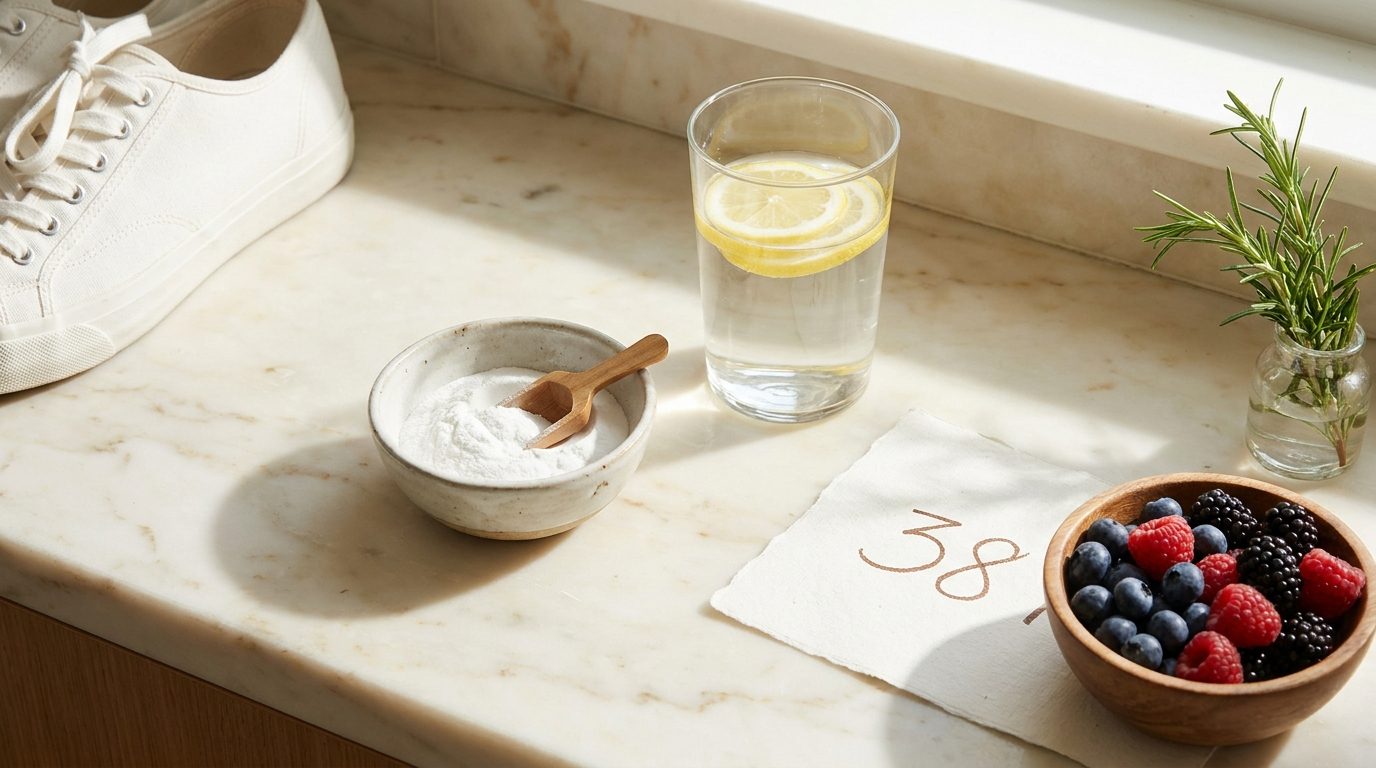
Turning 38 was the year the longevity research stopped feeling abstract. The decades of evidence about what protects women in their 40s and 50s started feeling like instructions for the next chapter, not background reading. So I made four changes — boring, sustainable, mostly free — and a year in, these are the ones I would write into a contract with my future self.
Three of them cost zero dollars. One of them costs about $25 for a six-month supply. None of them require a longevity clinic or a $400 supplement stack. All of them have research behind them that has held up across multiple studies, not just the latest podcast clip.
1. Strength training, twice a week, no more
The single change that has done the most for how my body feels at 38 and the change I most wish I had made at 28. Twice a week, 40 minutes each session, focused on the major lifts — squats (or split squats), deadlifts (or hip hinges), an upper body push, an upper body pull. That's it. No supersets, no metcons, no microloaded periodization scheme. Just heavy enough that the last two reps are hard, with two minutes of rest between sets.
Why this matters for longevity specifically: muscle mass starts declining around age 30 at about 1% per year, and accelerates after menopause. Muscle mass is the single largest predictor of metabolic health, bone density, and functional independence in women over 60. The window to build it is now. Cardio doesn't do this. Yoga doesn't do this. Strength training does.
(I wrote about the moment I switched from cardio to strength here, and it's the post I get the most "I started doing this" emails about. If you only do one of the four things on this list, do this one.)
2. 40 grams of protein at breakfast, no exceptions
The change I was most skeptical about and the one that has surprised me most. Forty grams of protein at breakfast — yes, that early, yes, every day. Not 20. Not 30. Forty.
The reasoning is rooted in what's called the leucine threshold — the amount of the amino acid leucine required to trigger muscle protein synthesis. The threshold rises with age. For women over 35, hitting it requires about 30–40 grams of high-quality protein in one sitting, three times a day. Most women eat 15–20 grams at breakfast (a yogurt cup and a piece of toast), which doesn't cross the threshold at all. The morning meal gets functionally wasted.
The thing nobody told me in my 20s: muscle isn't built by the calories you eat. It's built by the protein meals that cross a specific dose threshold. Below that threshold, the meal feeds you but doesn't build anything.
My version: three eggs + one cup of cottage cheese + a piece of fruit. About 42 grams, takes four minutes to prepare. Some mornings it's a protein smoothie with collagen + protein powder + berries — about 45 grams. Either way, the threshold is crossed by 7am.
This change is free. It just requires re-engineering what you reach for in the morning.
3. Zone 2 walking, 20 minutes, most days
The longevity researcher you've seen on every podcast (Peter Attia, Iñigo San-Millán) calls Zone 2 cardio the most important cardiovascular zone for healthspan. Zone 2 is the pace where you can hold a full conversation but it would be uncomfortable to sing. For most women that's a brisk walk — not a run, not a saunter. A walk where you're slightly out of breath but you could keep going for an hour.
The mechanism is mitochondrial. Zone 2 specifically trains mitochondrial density and function, which is the cellular substrate of basically every metabolic process in your body — energy production, glucose handling, fat oxidation. Decline in mitochondrial function is a primary driver of midlife metabolic problems (weight gain, insulin resistance, fatigue). Zone 2 is the intervention with the strongest evidence for reversing it.
I get this in two forms: the post-lunch walk I described in the biohacks post (10–15 minutes), and a longer 30-minute brisk walk on Saturday or Sunday morning. About 4 hours of total Zone 2 per week, which is in the range the research uses.
Free. Requires sneakers and a sidewalk.
4. Creatine monohydrate, 5 grams a day ($25 for 6 months)
The supplement I most regret not starting earlier. Creatine monohydrate, 5 grams a day, mixed into water or smoothie or coffee. Tastes like nothing.
The case for creatine for women over 35 is, at this point, embarrassingly strong. The research base — hundreds of studies, decades old — covers muscle strength, bone density, cognitive function, mood, and even some emerging data on brain health and cognitive decline. The reason most women haven't taken it is decades of marketing positioning it as a "men's bodybuilding" supplement, which has nothing to do with the science.
What it does for women specifically: improves the response to strength training (so your habit #1 above produces better results), supports bone density (more important than ever as estrogen starts to shift), and there's growing evidence for cognitive benefits especially under sleep deprivation, which most moms are chronically dealing with.
Dose: 5 grams a day, consistently. Brand: monohydrate (NOT the proprietary blends that cost three times as much). About $25 for a 90-serving tub which lasts six months. (For more on what to look for on the label of any supplement, here's the longer version.)
What's NOT on this list, and why
A few things you might expect that aren't here, by design.
- Intermittent fasting. The longevity claims have not held up well in the research for women, and protein-deprived women in their 40s end up with worse muscle outcomes. Skip.
- Cold plunges. The benefits are real but modest, and the time/setup cost is high relative to the size of the benefit. If you have a setup already, fine. Don't build one for longevity reasons alone.
- Rapamycin / metformin / off-label longevity drugs. Not enough long-term human data, not appropriate for non-prescribed use, and the upside is small relative to the four habits above.
- NAD+ supplements / NMN. The hype has outpaced the evidence considerably. Save the $80 a month and put it somewhere with stronger data.
The honest framing
These four habits will not make me live to 100. Nothing on this list is a guarantee of anything. What they will do, in the aggregate, is make the next twenty years of my life feel structurally different than the previous twenty — stronger, less tired, less fragile, less subject to the slow physiological drift that defines a lot of midlife.
The longevity industry would love to sell you a $400 stack and a $5,000 ice bath as the path to a longer life. The actual research keeps pointing at the same boring four: strength, protein, Zone 2 cardio, and a small handful of well-evidenced supplements. Boring and free wins again. It usually does.

Heather Robles
Mom of four, teacher, and the founder of Wellness by Heather. I write honest, research-backed notes on the wellness products that actually earn a spot in my routine — and the ones that don't.