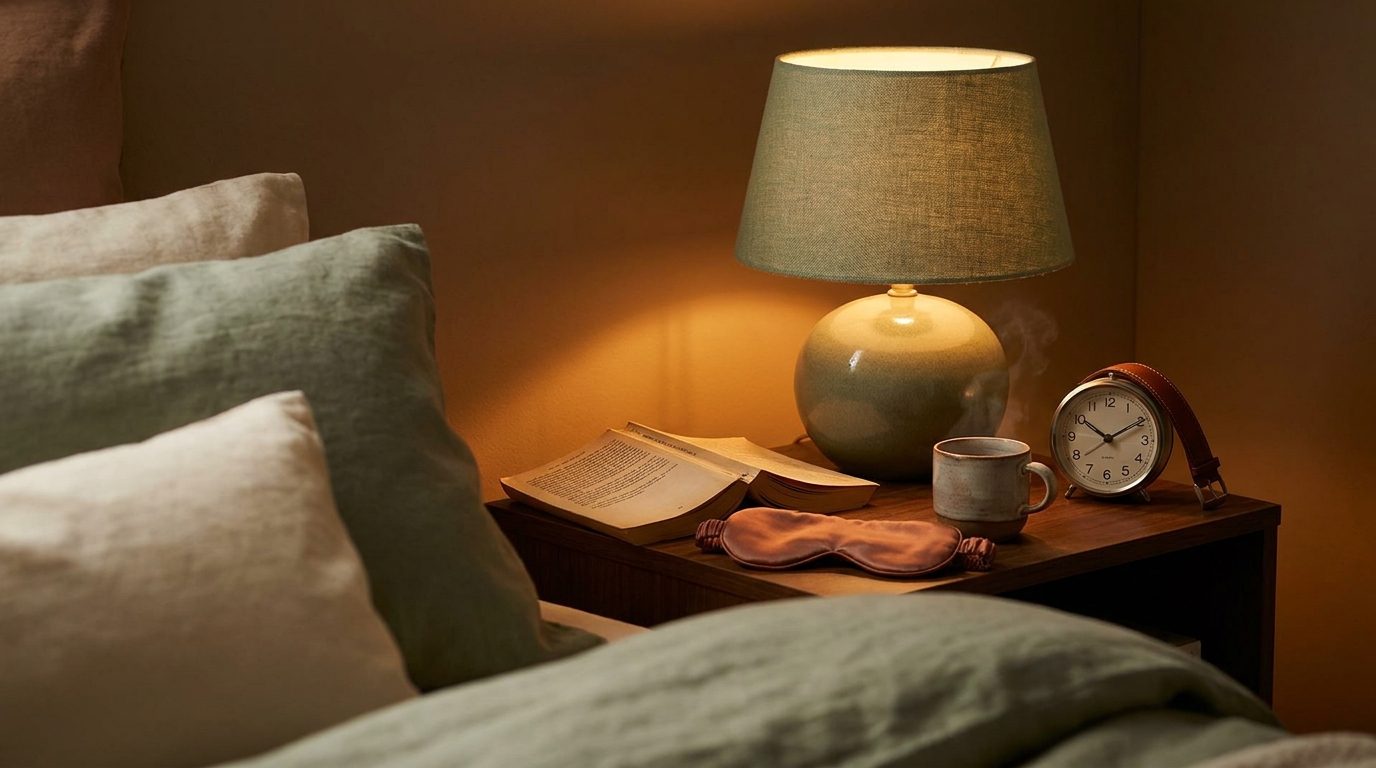
Most wind-down routines on the internet are written for someone with a different life. They assume you have ninety quiet minutes between when the kids go down and when you do. They include the word "spa." Many of them open with a candle. If your evenings end with one kid still asking for water at 9:14, a load of laundry that has to switch over before bed, and a 5am alarm waiting on the other side — those routines aren't useful to you.
What follows is the version I actually do on a normal Tuesday. It is thirty minutes from start to lights-out. It includes exactly zero candles. It assumes you have between four and six kids, a real job, and a normal amount of bedtime chaos. I built it after about a year of trial and error and these are the five steps, in the order they need to happen, with the honest reason each one matters.
The order matters more than the steps
Most wind-down advice gives you a list of things to do. The reason most lists fail is that they don't tell you the order. Some of these steps don't work unless the one before it has happened first. Doing them out of order is most of the reason people try a routine for a week and conclude it doesn't work.
The routine below is sequenced. Don't reshuffle it the first time you try it. If you want to swap steps later, do it after you've run the original sequence for two weeks.
The five-step routine, 30 minutes total
Step 1 (9:00pm, 2 minutes): Phone in the kitchen
The whole routine starts with this. Phone goes on the kitchen counter, on a charger, behind a closed door if you can swing it. Not "phone face down on the nightstand." Not "phone in airplane mode." Phone in a different room.
This is the step most women skip first because it feels like the smallest one. It is the most important one. Every other step in the routine assumes your attention isn't being grabbed back to a screen. Without this step, you will get to 11:14pm and not understand where the last two hours went.
If you genuinely need the phone in your room for emergencies — single parent, on-call work, kid in another city — get an old-school alarm clock and put the phone face-down across the room, plugged into a wall charger you have to physically stand up to reach. The friction is the point.
Step 2 (9:02pm, 8 minutes): Reset the kitchen
This sounds like it shouldn't be in a wind-down routine. It is the single biggest contributor to whether I sleep through the night.
Eight minutes: load the dishwasher, wipe the counters, put the next morning's coffee in the maker, set out tomorrow's coffee mug. Whatever your version of "the morning will not assault me when I walk into the kitchen at 5am" looks like.
The reason this works isn't the cleanliness. It's the mental closure. If you go to bed with the kitchen in chaos, your brain will rehearse the chaos in the background while you're trying to fall asleep — even if you don't notice it doing that. Eight minutes of physical closure on the day shuts that loop down before you ever climb into bed.
Step 3 (9:10pm, 10 minutes): The bedtime drink, made and started
Boil water. Make the four-ingredient drink. (Full recipe and the cost math here.) Carry it to the bedroom. Sit on the bed with it.
This step is doing three things at once. First, it's a behavioral signal — warm drink in a low-light room is a powerful cue to your nervous system that the day is over. Second, the magnesium glycinate in the drink is on its way to actually doing pharmacological work that will make falling asleep easier in about 45 minutes. Third, the act of sitting still with a mug for ten minutes, doing nothing else, is harder than it sounds — and is exactly the recalibration your nervous system needs after a day of being on.
The drink is the easy step to underrate. It's the only one in the routine that's doing both a physiological and a psychological job at the same time.
Step 4 (9:20pm, 8 minutes): Read a real book
Specifically a paper book. Specifically not a screen. The Kindle is fine on a long flight but it is a screen at 9:20pm and your nervous system will treat it like one.
Eight minutes is shorter than feels real. It is exactly the amount of time it takes to shift your brain out of whatever-you-were-doing mode and into something slower. The book doesn't need to be calming or aspirational — I've read trashy mysteries during this slot for months — it just needs to be linear paragraphs of language, not a feed of jagged short hits.
If you don't have a book going, pick one. Library. Used bookstore. Whatever you finally got around to wanting to read. The friction of "what should I read" is real and is the reason most people skip this step on day three. Keep one book on the nightstand at all times. When you finish it, put the next one there before you finish.
Step 5 (9:28pm, 2 minutes): Lights out, eye mask on
Eye mask matters. Even a small amount of ambient light from a streetlight, a smoke detector LED, or a partner's phone charger keeps melatonin suppressed. An eye mask costs ten dollars and adds 15-20 minutes of effective sleep most nights. Mine has a contoured shape so it doesn't press on my eyelashes.
Two minutes is the time it takes to set the alarm (on the alarm clock — phone is in the kitchen), drink the last of the bedtime drink, put the mug down, lie down, mask on. Done.
Lights out at 9:30pm sounds early. It is early. It is also the only thing that makes 5am workable. The math doesn't change just because you want it to.
What's NOT in this routine
I want to be specific about what got cut and why.
- Skincare beyond the basics. A two-minute splash of water and the same moisturizer I use in the morning. Anything more is in the morning slot, when my hands work better and I have caffeine.
- Meditation. Tried it for a year. For me, sitting still and trying to "let go of thoughts" produced more thoughts. The reading and the drink do the same thing without the performance. If meditation works for you, swap it for the book step.
- Journaling. Sometimes I do, mostly I don't. The kitchen reset is doing the same psychological work — closing the loop on the day. If I had to pick one, I'd pick the kitchen reset.
- Stretching or yoga. Important during the day. Not during the wind-down. Movement at 9:20pm activates more than it relaxes for me. Save the stretching for mornings.
- Reading the news. Whatever happened today, you cannot productively engage with it at 9:24pm. The world will still be there in the morning. Read a book that is not the news.
What this routine costs to start
Almost nothing. An eye mask ($10). A paper book (library, free). The ingredients for the bedtime drink (~$20 a month, recipe above). An alarm clock if you don't have one (~$15). Total one-time cost: about $25. Total monthly cost: about $20. It is the cheapest sleep intervention I've found that actually works.
What to do if you can't fall asleep after the routine
This will happen sometimes. Two rules.
First, do not pick up the phone. The phone is in the kitchen. The phone stays in the kitchen. If you bring the phone to bed because you "can't sleep anyway," you have just guaranteed you won't sleep for another hour, and you have also broken the routine for tomorrow night by retraining yourself to expect the phone is available.
Second, get up. If you've been in bed for twenty minutes and you're not asleep, get up, go to the kitchen (where the phone is, do not look at the phone), pour another half-cup of the chamomile-and-magnesium drink, sit in low light for fifteen minutes, then go back to bed. This breaks the bed-is-where-I-lie-awake association and is the technique sleep researchers actually recommend. It works because lying in bed wide-awake teaches your brain that the bed is the awake place.
The honest framing
This routine doesn't add hours to your night. It adds depth to the hours you have. The difference between six hours of fragmented anxious sleep and six hours of solid quiet sleep is genuinely the difference between a usable day and a struggle day. The longer version of why I built this routine in the first place is here.
Try it for two weeks. If after fourteen nights you don't notice anything, the routine isn't for you and that's fine. If after fourteen nights your fall-asleep time is twenty minutes faster — and it probably will be — keep going. The compounding helps. Month two is better than month one.

Heather Robles
Mom of four, teacher, and the founder of Wellness by Heather. I write honest, research-backed notes on the wellness products that actually earn a spot in my routine — and the ones that don't.