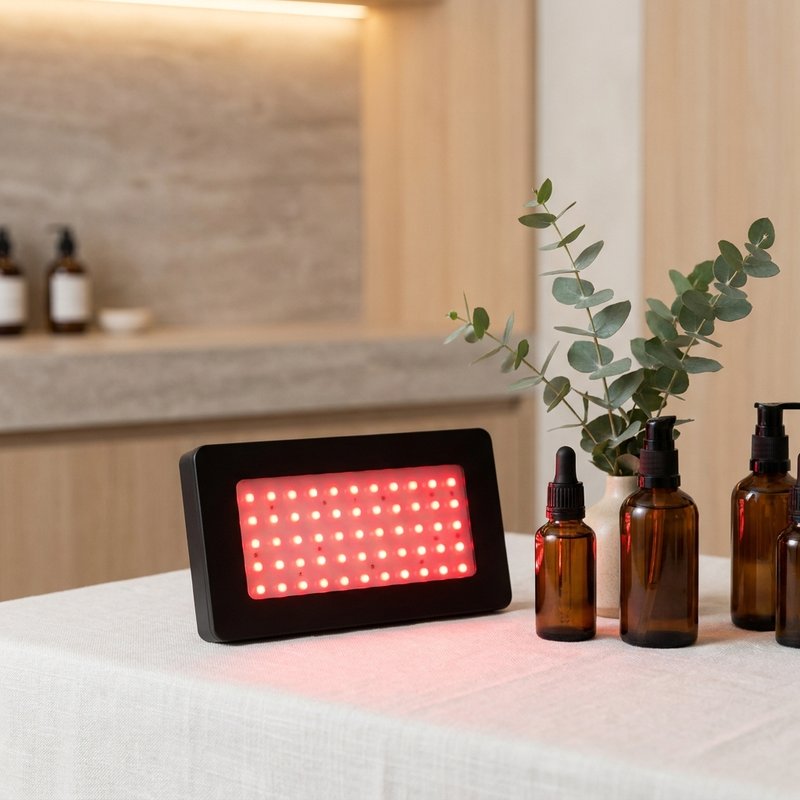
Red light therapy is in a weird moment. Five years ago you'd only encounter it at a dermatologist's office or a sports recovery clinic. Today there's a $30 LED mask on every drugstore endcap and a $1,800 panel on every wellness influencer's Instagram. The marketing has gotten ahead of most consumers' understanding of what the technology can actually do.
I tested it seriously for three months before forming an opinion. Here's the honest verdict — including the categories of claims that are well-supported by research, the categories that are not, and the price points where it starts to be worth your money.
What the technology actually is
Red light therapy (sometimes called photobiomodulation, or LLLT — low-level laser therapy) uses specific wavelengths of red and near-infrared light to penetrate the top layers of skin and trigger cellular responses. The two wavelength ranges that have the most research support:
- Red light (around 630–660 nm): Penetrates the upper layers of skin. Research support for skin texture, fine lines, and surface inflammation.
- Near-infrared (around 810–850 nm): Penetrates deeper — into muscle, joint, and connective tissue. Research support for recovery, joint discomfort, and circulation.
If a device doesn't tell you its wavelength range, treat that as a yellow flag. The wavelength is the entire mechanism. A "red light" device that just emits a vague red glow without the specific therapeutic wavelengths is mostly decorative.
What the research actually supports
I split this into two columns when I was sorting through the studies — the strong-evidence claims and the weak-evidence claims. The strong column is shorter than the marketing suggests. The weak column has most of the things people are buying it for.
Strong evidence
- Skin texture and fine wrinkles — Meta-analyses on consistent home red light use (15–20 minutes, 3–5 times a week, for at least 12 weeks) show modest but real improvements in collagen production and skin smoothness.
- Wound and post-procedure healing — Used clinically for years; well-supported in the research.
- Muscle recovery — Near-infrared shows decent evidence for reducing post-exercise soreness and supporting recovery, especially in athletes training at volume.
- Surface inflammation, including acne — Specific wavelengths (often blue + red combined for acne) have FDA clearance for this use case.
Weak or mixed evidence
- Hair regrowth. The evidence here is genuinely mixed. Some studies show modest regrowth in androgenetic alopecia; others show nothing. The honest answer is "maybe, in some cases."
- Weight loss / fat reduction. Mostly marketing. The studies that exist usually involve clinical settings with very specific protocols, and the effect sizes are small.
- "Detox" / "cellular energy" / "mitochondrial health." These are real mechanisms in the research, but the leap from "this happens at the cellular level" to "you will feel meaningfully better" is mostly marketing.
- Mental health benefits. Early research on transcranial near-infrared exists. It is not at the level where a $200 desk panel is going to fix depression.
The honest summary: red light is a real technology with a few genuinely well-supported uses, and a much longer list of uses where the marketing got ahead of the science. (For the broader pattern of how supplement and wellness marketing tends to overrun the research, here's a related read.)
Where the price points actually make sense
This is where most consumers get into trouble. The home red light market has three roughly distinct tiers, and the marketing tries hard to make all three look interchangeable.
Tier one: under $100 (LED masks, small wands)
These are the products you'll see at Sephora and on Instagram. Most of them have weak wavelength output and short treatment times. The truly cheap ones don't even publish their irradiance numbers. Honest take: some of them work for surface skin texture if used very consistently for several months. None of them are powerful enough to do anything for joints, muscles, or anything deeper than skin surface.
If you're buying a Tier 1 product specifically for fine-line and texture improvement on the face, and you'll use it 4–5 times a week without exception for at least three months, it's possible to get some return. If you're buying it for any other reason, you're paying for the box.
Tier two: $300–$800 (sauna blankets, mid-range panels)
This is the tier where things get interesting and also where the most marketing happens. Infrared sauna blankets fall here. They're a real category — there's reasonable evidence for circulation, sweat-based recovery, and parasympathetic activation. The honest case for them is "a controlled, comfortable, low-effort way to get sauna-like effects at home."
Mid-range red light panels in this tier are where home users get the most reasonable bang for their buck IF they use them consistently. The catch: most people don't. The panel becomes a piece of furniture.
Tier three: $1,000+ (full-body panels)
This tier is for serious users with specific goals — athletes managing chronic injury, people working under a doctor's protocol, biohackers tracking specific markers. For a general home user looking to "feel better" or "have nicer skin," Tier 3 is overkill by about $1,500.
My actual recommendation
If you've never tried red light therapy and you're curious, here's what I'd actually do:
- Start with one specific goal. Skin texture? Recovery from a specific injury? Sleep? Pick one. The "everything benefits" approach leads to no consistent use, which leads to no results, which leads to a $400 panel in the closet.
- Match the tier to the goal. Skin texture only: Tier 1 mask, used religiously. Recovery or general wellness: Tier 2 panel or sauna blanket. Sport-level recovery: Tier 3 if you can afford it.
- Commit to a 90-day test window before deciding. Most red light effects show up around weeks 6–12. Quitting at week 3 because you don't see anything is the most common reason it "doesn't work" — and also why so many devices end up on Facebook Marketplace.
- Track one specific marker. Photo of your skin in the same window light every two weeks. Or recovery score from your morning workout. Or your hair growth from a specific spot. Don't try to evaluate everything. Pick the one thing your purchase was for.
The technology is real. The marketing is louder than the science. The consumers who get the most out of it are the ones who buy for a specific goal and stick to a specific protocol.
If you remember nothing else: red light therapy is a slow, modest, real technology. The brands selling it as fast, dramatic, transformative are overselling — and the brands selling it as "the wellness ritual that will change your life" are the ones I'd walk past.
The boring brands with the actual wavelength numbers on the packaging? Those are usually the ones worth the money.

Heather Robles
Mom of four, teacher, and the founder of Wellness by Heather. I write honest, research-backed notes on the wellness products that actually earn a spot in my routine — and the ones that don't.