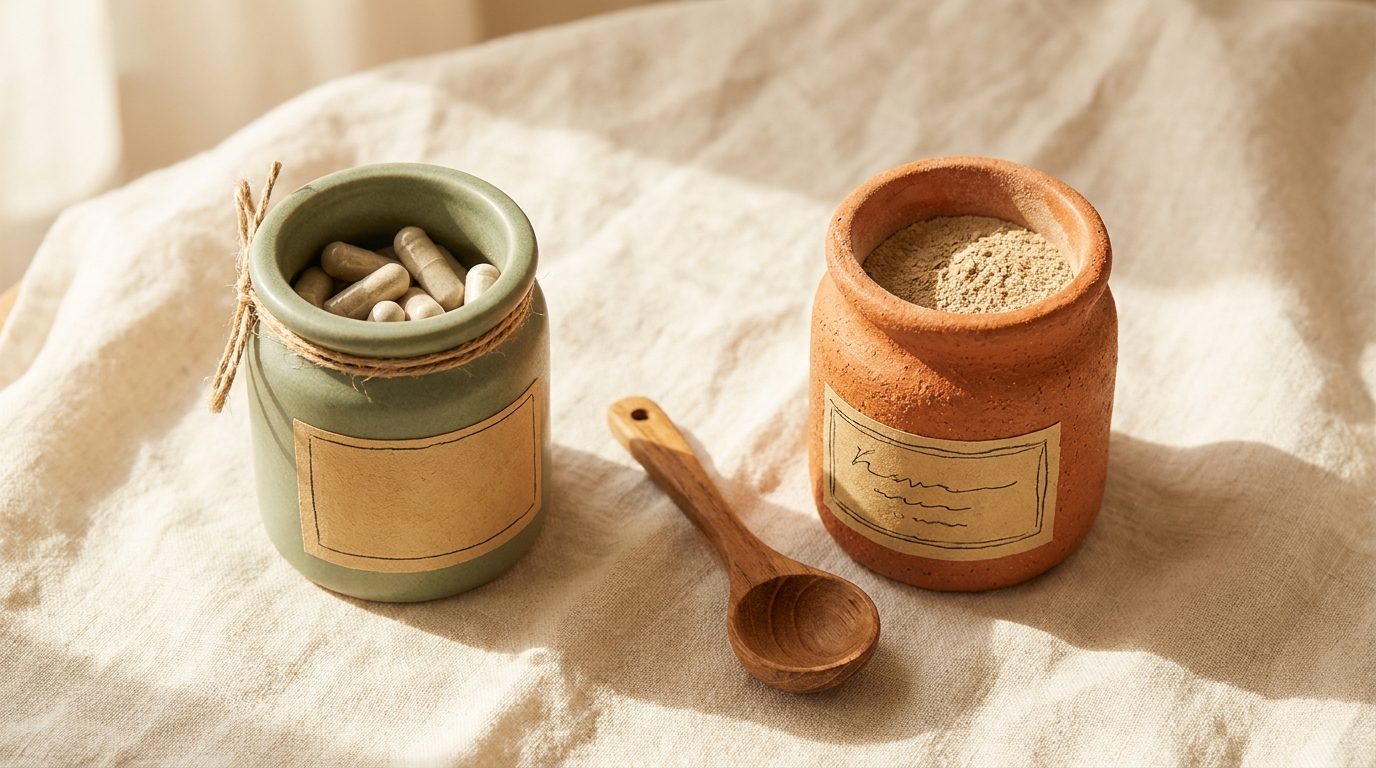
Most women's gut routines have a probiotic. Most women's gut routines do not have a prebiotic. The first one without the second one is doing roughly half of what it could be doing. Here's the difference in the simplest possible terms.
Probiotics: the bacteria
Probiotics are the live bacteria themselves. The strains you're swallowing in a capsule. Brands like Just Thrive, Garden of Life, Seed — those are probiotic brands. The product contains specific strains of bacteria (Lactobacillus, Bifidobacterium, Bacillus, and others) that are meant to take up residence in your gut.
Probiotic capsules deliver bacteria. That's their whole job. They are like planting seeds.
Prebiotics: the food the bacteria eat
Prebiotics are the fiber and polyphenols that your gut bacteria — the ones already there plus the ones you just added — actually feed on. Without prebiotics, the bacteria can't establish, can't multiply, and can't do anything for you. They just pass through.
Prebiotics are like the soil and water you give the seeds. You can plant a thousand seeds in a parking lot and almost none of them will grow.
Most prebiotics come from food, not supplements. The big sources:
- Onions, garlic, leeks
- Asparagus, artichokes
- Oats, barley
- Legumes (beans, lentils, chickpeas)
- Apples and bananas (especially slightly underripe bananas)
- Most leafy greens
- Flaxseed and chia seed
You can also buy a prebiotic supplement (usually inulin, FOS, or partially hydrolyzed guar gum), but most people who eat a varied diet with the foods above don't need one.
The 60-second decision tree
- If you're already eating a varied plant-rich diet, the foods above are doing the prebiotic job. You don't need a prebiotic supplement. You may still benefit from a probiotic for specific reasons.
- If your diet is low in plant variety, fixing the diet matters more than buying a probiotic. The probiotic without the food is half a system.
- If you're doing both — eating the plant foods and taking a probiotic — that's the version where probiotics actually earn their cost.
Probiotics are the headliner the supplement industry sells. Prebiotics are the supporting cast the supplement industry doesn't make money on. Guess which one matters more for most women.
The product trap to watch for
A growing category of products bundle "probiotic + prebiotic" (sometimes called "synbiotic") into one capsule. Most of these are fine but not necessary if you eat reasonably. They tend to be more expensive than buying the two separately would be. The marketing implies you need both in the same pill — you don't.
If you're going to invest in a gut supplement, my honest order is: fix the food first, then add the probiotic if there's still a reason to. Most of the time the food does the work, and the supplement is a small additional lever.
(More on the specific probiotic mistakes I made — and the five things I wish I'd known before my first capsule — here.)

Heather Robles
Mom of four, teacher, and the founder of Wellness by Heather. I write honest, research-backed notes on the wellness products that actually earn a spot in my routine — and the ones that don't.