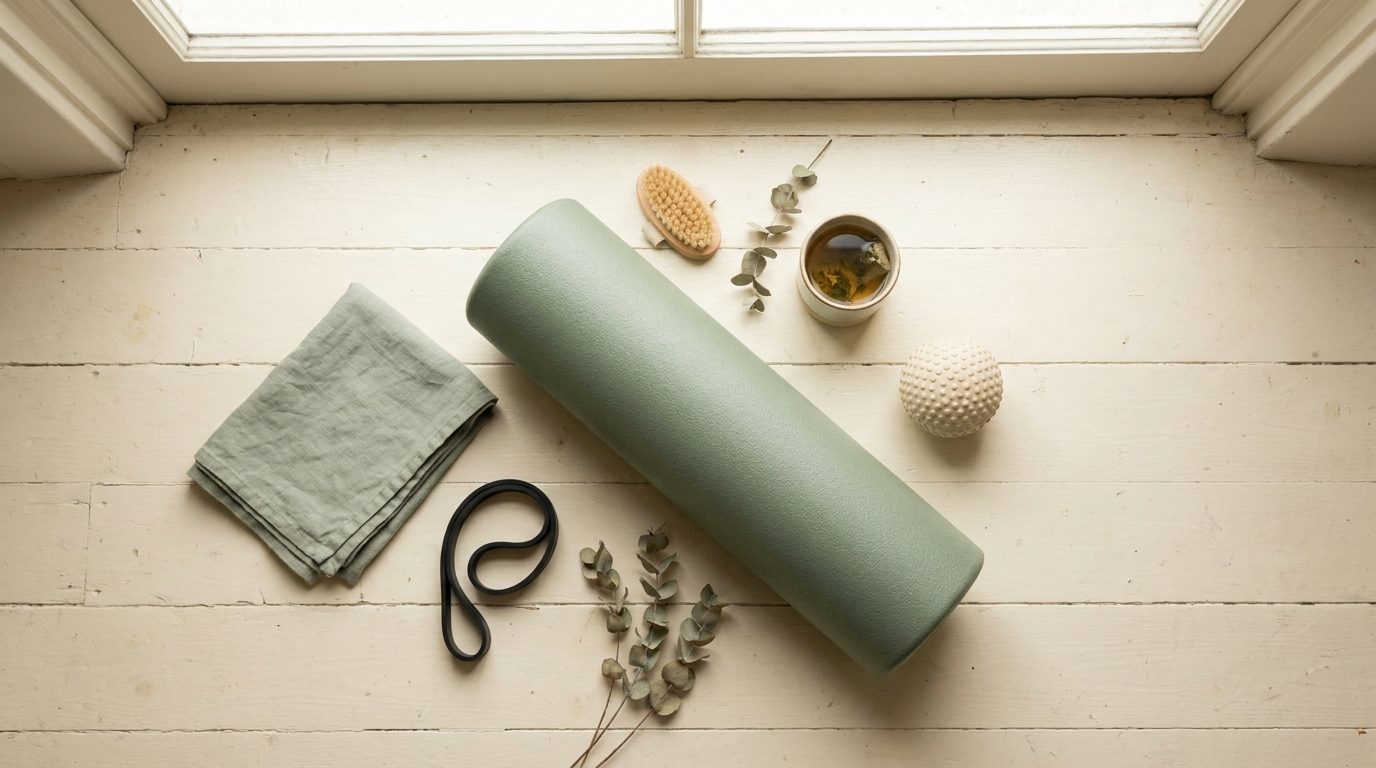
I've been gifted, loaned, and tested most of the expensive recovery devices on the market — Theragun, compression boots, a $400 stretch tower, three different vibrating foam rollers. After two years of testing, the tools I actually reach for at the end of the day are the three cheapest things on the list. Total cost: $45. Combined, they have done more for my chronic lower back tension and post-workout recovery than any of the $300+ devices I tried.
Here are the three, in order of how often I use them. Each one replaces a category of expensive gear that the wellness internet would tell you is essential. It isn't.
1. A standard foam roller ($20–$30)
The cheapest recovery tool that does the most. A standard high-density foam roller, 36 inches long, smooth surface, not the spiky vibrating kind. About $25 from Amazon or any sporting goods store.
Used on the upper back, glutes, IT band, and quads for about 10 minutes a night, it does most of what a Theragun ($300) and a massage chair ($2,000) would do for general post-workout recovery and post-day desk tension. The reason is structural — fascia and muscle respond to sustained pressure, and a foam roller delivers sustained pressure across a large surface area in a way that a percussive device can't. The Theragun is faster and more targeted, but the foam roller is more thorough.
What to look for: 36-inch length (long enough for the upper back), high-density foam (the cheap soft ones compress flat after a month), smooth surface (textured rollers are for advanced users and you don't need them).
I keep mine vertical against the bedroom wall. The visibility cue matters — if it's in the closet, you'll never use it.
2. A lacrosse ball or textured massage ball ($10–$15)
What the foam roller can't reach — the deep tissue spots, especially in the glutes, between the shoulder blades, in the bottom of the feet — a massage ball does. A lacrosse ball from a sporting goods store works perfectly and costs $10. A textured massage ball (the ones with rubber nubs) gives slightly more variability for around $15.
This is the tool that replaces compression boots ($800), a deep tissue massage ($120 per session), and the trigger-point therapy that physical therapists charge $200 an hour for. None of those things are bad — but for the chronic stuff that recurs week after week, a $10 ball does 80% of the work.
The mistake I made for years was assuming that something that costs more works better. The foam roller and the lacrosse ball are humbling examples of how the opposite is often true. The simplicity isn't a weakness; it's why they survive in my routine.
My specific routine: ten minutes of foam rolling, then ball work on the glutes (each side, three minutes), then the bottoms of the feet for two minutes. Total time: 17 minutes. Total cost: $35. I do this most nights while watching TV with my husband — recovery and family time stack neatly.
3. A resistance band loop ($10–$15)
The recovery tool that nobody calls a recovery tool but absolutely is. A short fabric resistance band loop — the kind that's about 12 inches in circumference and comes in three resistance levels in a single $15 set. About $10 if you buy them individually.
What it does: activates the glutes, opens up tight hips, and corrects the postural muscle imbalances that come from sitting all day. Five minutes of band work — clamshells, lateral steps, glute bridges with a band — before bed addresses the upstream cause of most lower back pain, which is weak and underactive glutes from too much sitting.
This replaces an entire category of physical therapy work (typically $200 a session). The mechanism isn't passive recovery like the foam roller — it's active stabilization training. But because most chronic adult pain comes from postural weakness, not from acute injury, the band loop ends up doing more for back pain than any passive recovery device ever did for me.
What to look for: fabric not rubber (the rubber ones roll and bunch on bare skin), three resistance levels (start light, build up), short loop length (12-inch is the standard).
The one feature to look for in any recovery tool
If I had to give a single rule for buying any recovery product: buy the thing you will leave visible.
The foam roller against the wall. The lacrosse ball on the nightstand. The resistance band loop on the dresser. The expensive devices that sit in a drawer or in a closet are not recovery tools — they are decoration for somebody else's house. The cheap tools that live where you can see them are the ones you will actually use, and consistency beats every other variable in this category by a wide margin.
This is why I stopped buying the gadgets. A $300 Theragun lives in its custom case in a drawer. A $25 foam roller lives leaning against my wall. The roller wins because friction wins.
What I tried and stopped using
For completeness:
- Theragun. Worked beautifully for the first month, gradually stopped using because the friction of finding it, charging it, and selecting the right head was higher than the friction of just rolling on a foam roller.
- Compression boots (loaner). Loved them. Returned them. The 30-minute session time is real and I never made room for it.
- Vibrating foam roller. The battery died after eight months. The non-vibrating $25 roller is still going after two years.
- Acupressure mat. Polarizing — some people love these. I found the discomfort genuinely uncomfortable in a way that didn't pay off in benefit.
- Stretch tower. $400 in my garage, used twice. Donated.
The honest framing
Recovery is a category where the wellness industry has done a particularly aggressive job of convincing people that effective tools must be expensive. The truth is the opposite — recovery is one of the most equipment-light wellness categories that exists, and most of the high-priced devices are solving problems you don't have with marketing copy that overpromises.
Spend $45 on the three things above. Use them five nights a week. Skip everything else in this category for at least six months. By the end of that period, if you still feel like you need a $300 device, the data point at least is real — you've earned the upgrade. But almost nobody who tries the $45 stack consistently ever feels like they need to.

Heather Robles
Mom of four, teacher, and the founder of Wellness by Heather. I write honest, research-backed notes on the wellness products that actually earn a spot in my routine — and the ones that don't.